
Are you exploring healthcare careers but not sure which path fits your skills, interests, or goals? This guide helps you compare top healthcare career paths — from clinical roles like nursing and radiology to technical and administrative positions — and outlines how to choose one based on growth, salary, education requirements, and day-to-day responsibilities. You’ll also learn how starting with a general studies in pre-health sciences program or certificate can help you begin your healthcare journey, build credentials, and plan the next steps in your education or career.
Whether you are new to college or looking for a new career, here’s how to explore healthcare careers and find the right job for your career goals.
In this guide you’ll discover:
- Top healthcare careers and what they involve
- Typical education level and training time
- Median salary and growth trends
- Key questions to ask yourself
Bonus: Take a healthcare career quiz to see what jobs you connect with.
In this Article
How to Choose a Healthcare Career
Healthcare careers are divided along three tracks: clinical, technical, and administrative.
Clinical careers refer to direct patient contact, such as doctors, nurses, dental hygienists, phlebotomists, etc. Sonography and radiology technicians fall under the clinical track because techs work directly with patients but do not consult or diagnose.
Technical careers include health data analysts, public health researchers, or records management.
Administrative roles include practice and office management.
When asking, “what healthcare career is right for me?” here are some of the questions you should ask yourself.
- Which jobs match my interests and strengths?
- Do I want to work directly with patients?
- What kind of education do I like — classroom, workplace, or a mix of both?
- How long does training take?
- What are typical salaries and job growth trends?
Healthcare Classes and Prerequisites
Getting a healthcare degree requires specific degree courses as well as general education classes. At ACC, students must first declare a major in General Studies in Pre-Health Sciences. These classes form the foundation of a healthcare degree.
Nursing classes and clinical experience prepare students to pass the NCLEX, which is required to become a registered nurse, or RN. Therefore, it’s important to choose a nursing program that has a high NCLEX pass rate, as ACC does.
The ACC associate degree in nursing program plan covers the following classes and prerequisites:
| Prerequisites* | Semester I | Semester II | Semester III | Semester IV |
| Anatomy and Physiology I | Foundations for Nursing Practice | Complex Concepts of Adult Health | Nursing Care of the Childbearing and Childrearing Family | Enhanced Concepts of Adult Health |
| Microbiology | Clinical-Nursing-Registered Nurse Training: Foundations of Nursing | Clinical-Registered Nursing/Registered Nurse Training II | Clinical-Registered Nursing/ Registered Nurse: Childbearing/ Childrearing Family |
Registered Nursing, Registered Nurse Training IV OR Registered Nursing/ Registered Nurse – Advanced Clinical Immersion IV |
| Anatomy and Physiology II | Common Concepts of Adult Health | Concepts of Clinical Decision-Making I | Mental Health Nursing | Professional Nursing: Leadership and Management |
| Pharmacology for Health Professions | Clinical-Registered Nursing/Registered Nurse Training I | Registered Nursing, Registered Nurse: Mental Health | Ethics | |
| Nursing Skills | Introduction to Psychology | English Composition I** |
*part of the General Studies in Pre-Health Sciences degree plan
**can be taken prior to starting the program
ACC Healthcare Degree Options
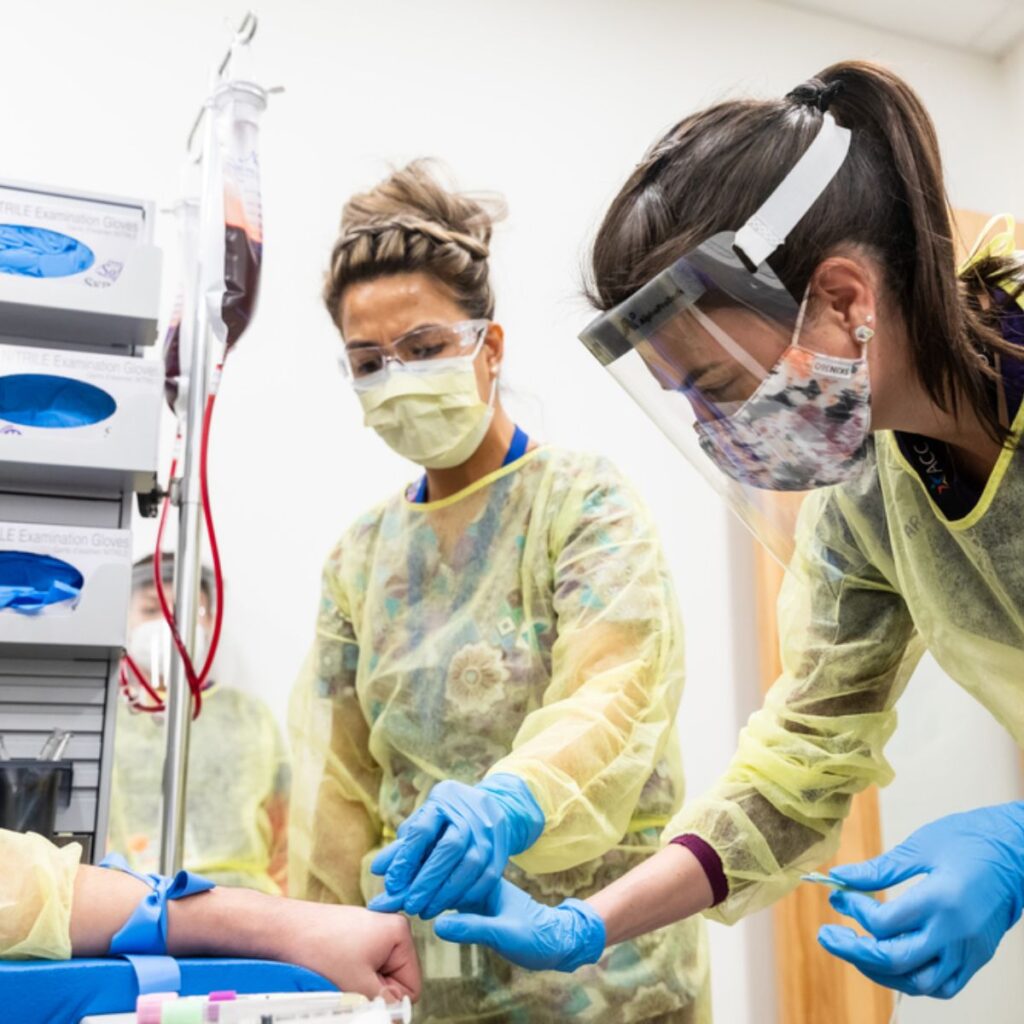
ACC offers associate of science (AS) degrees, associate of applied science (AAS) degrees, certificates, and a Bachelor’s of Science in Nursing (BSN).
AS degrees prepare students for transfer to a four-year university. Students who plan to transfer to a four-year school should check with their destination school to make sure that credits transfer.
AAS degrees and certificates prepare students to directly enter the workforce.
At ACC, certificates are stackable, which means that each time a student completes a certificate, many of those credits count toward the next one. This is an efficient way to earn certificates and an associate’s degree. It allows students to skill up and get into the workforce quickly, earning money while they get their next certificate.
ACC also offers an RN to BSN program. This program lets eligible students get their bachelor’s degree in one year, paving the way for higher wages, advanced nursing degrees, and leadership roles.
Types of Healthcare Careers You Can Start at ACC
Take the first step toward a fascinating career in healthcare. Explore different careers in healthcare at ACC, such as the programs below.
Nursing
Nursing is a clinical profession, which means that nurses treat and care for patients. ACC nursing students can choose the RN (Registered Nurse) or LVN (Licensed Vocational Nurse) through an associate degree program. ACC also has an RN-to-BSN program for nurses who want to grow their careers and salary. The ACC nursing program has one of the highest NCLEX (national nursing exam) pass rates in Texas.
Salaries for nurses vary, with RNs earning a median wage of $45 per hour in 2024, and LVNs earning $29.97 per hour, according to the Bureau of Labor Statistics.
Dental Hygiene
Dental hygienists learn to care for patients’ teeth. They can identify oral issues and help educate patients on dental care. Students earn an associate’s degree. Median wage for a dental hygienist was just over $45.32 per hour in 2024, per the BLS.
Radiology Technician
ACC offers an associate’s degree in diagnostic imaging. Students can also earn advanced certificates in cardiovascular intervention, magnetic resonance imaging, and cardiovascular interventional technology. In 2024 the median annual wage was $37.97 per hour.
Pharmacy Technician
Students can earn a pharmacy technician associate degree as well as advanced certificates. ACC offers training in state-of-the-art facilities. In 2024 the median annual wage for a pharmacy technician was $20.90 per hour.
Occupational Therapy Assistant
Occupational therapy assistants work in hospitals, clinics, and other healthcare settings. ACC’s program has a 100% certification pass rate. Median annual wage was $31.47 per hour in 2024.
Phlebotomy
Start your healthcare career with a certificate in phlebotomy. Learn to draw blood, the principles of labwork, and other healthcare skills. Students can use their phlebotomy certificate to enter the workforce and as the basis for more advanced studies. Median annual wage was about $20.99 per hour in 2024.
Emergency Medical Services
Earn an associate’s degree or certificates in emergency medical response. Students learn how to assess, treat, and transport patients in emergency situations. Median annual wage was $22.28 per hour in 2024.
Surgical Technician
Students learn how to assist in surgeries in ACC’s surgical tech program. Skills include surgical equipment prep, specimen handling, and operating room procedures. Students can earn an associate’s degree. Median annual wage was $30.04 per hour in 2024.
Take Your First Step to a New Career
“What healthcare career is right for me?” Hopefully this overview gave you a few ideas. Take the next step and explore healthcare programs at ACC and find a rewarding career.
Tags: health sciences, healthcare, healthcare career, nursing
Back to Top